Categories
Uncategorized

Education strategy is a major tool to apply politics

I have chosen to study at university at this time to be able to apply my new knowledge which I have acquired lately in photography after my stay in Italy studying Design.

Photography interested me through out my studies from fine arts ti Architecture most specifically when I have to find a relationship between my artistic skills which are applied and my way to deal with my surroundings.

Many concepts have been used to get represented through photographs or many concepts have been made to be photographed.

Dealing/playing with both sides of representation is the secret from which you shall remember to respect your imaginative aspects of creation.

Creationism is divided in two different views.

By choosing to focus on Photography, my specific GOAL shall give you the opportunity to raise your dynamic status by listen carefully to the spectacle. Sight views are prohibited.

Categories
Uncategorized

Politics continues with a portfolio, one degustation

Categories
Uncategorized

First Christian architecture

Romanesque Architecture, Its context, Architectural elements: What characterizes the romanesque? An example of Romanesque: Saint Martin, c 1050. In addition to the use of Arches and Blind Arches. Use of Barrel and Groin Vaulting. The rest of the uses will be posted in images not in person, for example St Philibert de Tornus, 950-c 1120.

The Basilica

Origins

•  Roman Public Building in the center of a Roman city

Architectural Description

  • •  Big hall for legal and commercial affairs
  • •  Interior colonnade that divides the space into a a nave and aisles
  • •  Apse where the cathedra is located (seat of the magistrate)
  • •  The central Nave usually larger than the aisles
  • •  Includes high windows

Why the Basilica?

•  In the fourth century Christianity is recognized as an official religion of the roman empire under Constantine the Great

– Christians go from hidden to public spaces –With imperial financing, they can start to think of building public spaces

– But why not choose the already established form of a Pagan Temple?

  • •  Association between the Temple form and paganism: the use of the basilica publicly affirms a difference
  • •  The architectural formula of the temple is not adapted to Christian rituals
  • •  A pre-existing model is needed (known plans, feasible, having proven its worth)

Transformation into a place of Christian Worship

•  In the Apse, instead of the Magistrate a Priest

•  The basilical plan can accommodate a large number of individuals

•  Easily lit because of the high windows

Byzantine Architecture, The beginning of a divergence between Roman and Byzantine architecture under the reign of Justinian the Great, The Dome as an example could be the most reliable sign.

Best Regards, X

Categories
Uncategorized

Beirut Battles and its History

For Bernard Khoury, Beirut’s relationship with its heritage is a false one, marked by Orientalist romanticism and a fascination with war. The Lebanese architect talks about the gaps in the city’s memory, gaps which the weakness of the State and the omnipotence of private interests do nothing to fill.

This article was featured in L’ Architecture d’Aujourd’hui in November 2011, written by Marie-Douce Albert.

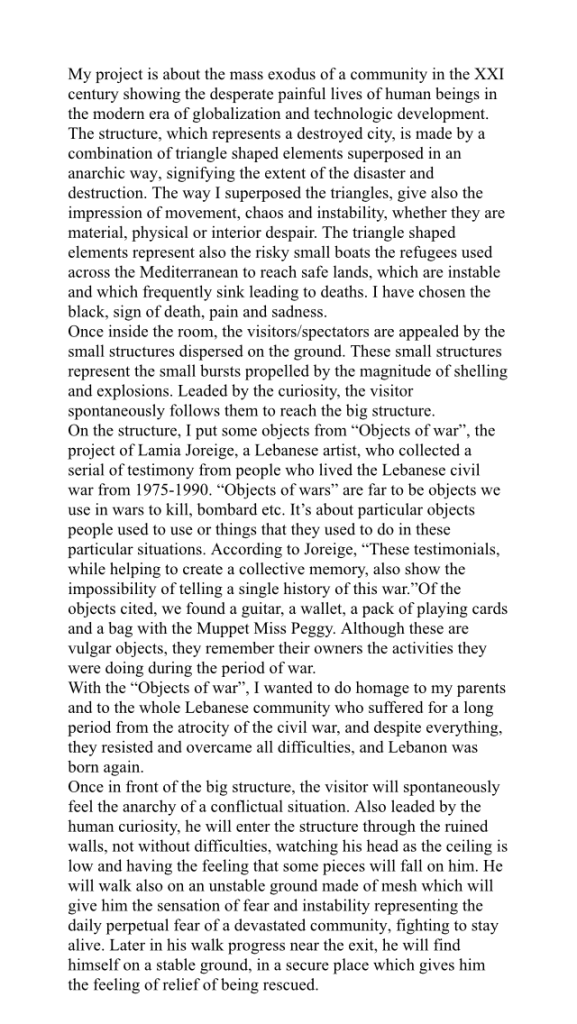
Centre-ville de Beirut
The Place de l’Etoile area. “A painstaking rehabilitation, an impressive work.”
Apparently, Bernard Khoury is not the kind of man to hide his opinions behind a veil of politeness. When asked about the relationship between his country and its heritage, his response is far from optimistic. Of course, major world famous sites like Baalbek and Byblos are, he admits, “well conserved”. But, he continues, “it’s best not to look too closely at what lies beyond them. This country’s landscape has been disfigured. Not by the war. No, the damage caused by anarchic real estate development is a good deal worse. The problem is the State, which has been entirely absent. Did you know that there is no part of the country that can’t be built on?” In a few well-chosen phrases the architect paints the portrait of a totally bankrupt government. “Nothing of what’s still in the hands of the State actually works. For example, we don’t always have electricity around the clock. Everything that’s been done so far has been done by private companies.” After years of war, the reconstruction effort in Beirut and Lebanon as a whole has been characterized by a distinct lack of regulation. And consequently, particularly insofar as architectural heritage is concerned, there is an absence of any vision that goes beyond economic interes
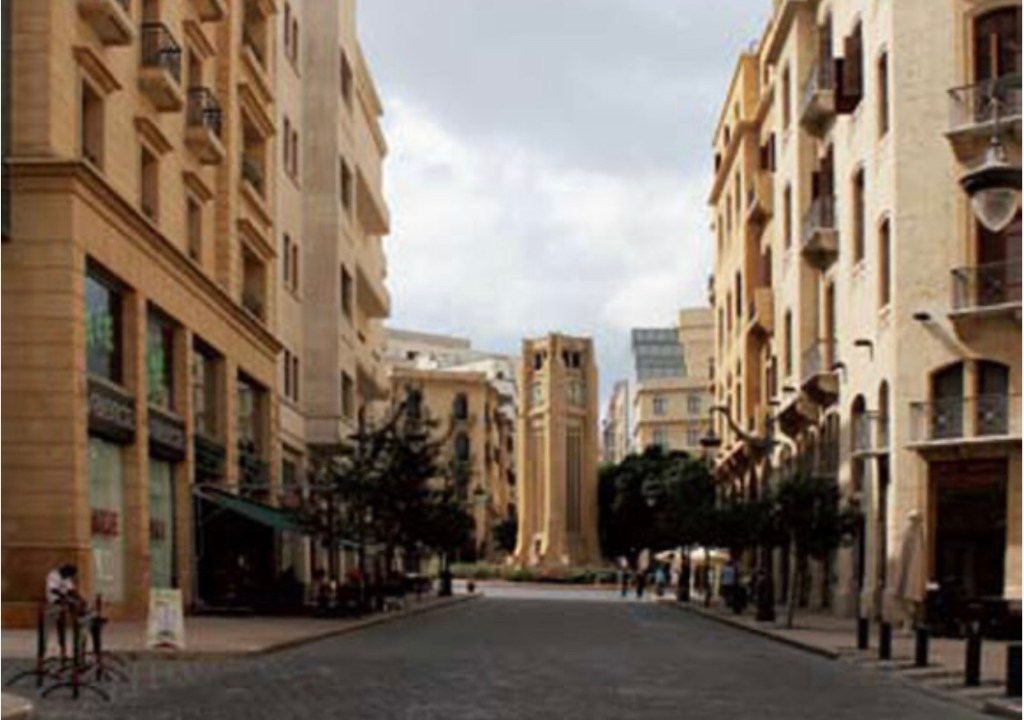
Saifi village. ‘A clumsy rendition of simplistic view of history”

In reality, at least, “because on paper, conservation mechanisms do exist.For example, the Apsad (the Association for the Protection of Sites and Ancient Dwellings) established a list of a thousand or so buildings of historical interest in Beirut and then attempted to classify them. The list was shortened to around 250 untouchable sites. But even some of those were demolished” Khoury says, with a tinge of regret.

In the last few years there has been a good deal of criticism of the behaviour of the real estate investment firm, Solidere [Lebanese Company for Development and Reconstruction], of which the former prime minister, Rafik Hariri was a major shareholder. Hariri was accused of “bulldozing 85% of the Arabic- Ottoman heritage [1].” On this point, Bernard Khoury takes a less categorical view, recognizing not only the work done on archaeological excavations but also on the rehabilitation of a number of important buildings. Indeed, could anything more bedemanded of a private company when the country as a whole “is incapable of writing its own history”? And the architect continues: “It’s very sad now that in school books history stops in 1975, the official date of the beginning of the civil war. But in terms of conserving heritage, it actually stops before then, with the end of the French mandate. The only slightly syrupy consensus that we have recognizes heritage from ancient times up until 1943.”

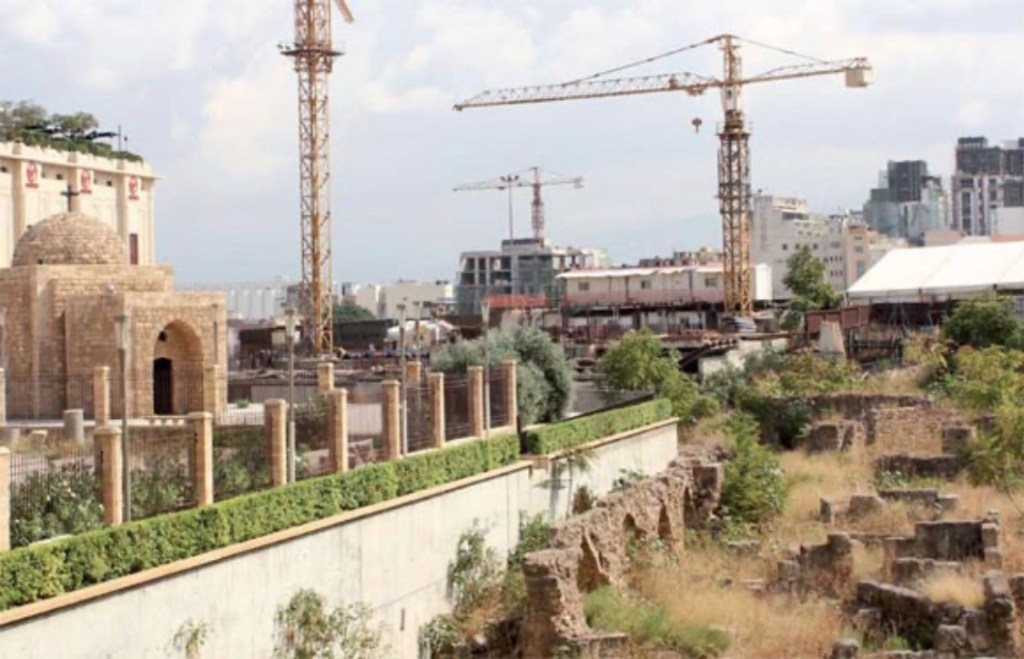
Archeological excavation near the Place des Martyrs.

As an immediate consequence, Beirut has a false relationship with its past, characterized by a “superficially Arabocentric” kind of nostalgia, Khoury adds, adding that the city has not escaped “the architectural failures that, since 1970, have disfigured so many places around the world with their somewhat unhealthy preoccupation with the past. We’ve produced a kind of architecture that claimed to be ‘Lebanese’ but that was reinterpreted in a totally romantic way. We focused on reproduction by building badly designed copies full of errors of syntax and vocabulary.” According to the architect, the dominant “mashrabiya” style is a travesty. “It’s all the more perverse,” he says, “in that in reality we are perpetuating the Orientalist fantasies developed in the West…” Just as worryingly, Beirut obscures an important swathe of its history. “The Republican period, from 1943 to the 1970s, witnessed the emergence of a kind of modern architecture,” Khoury says, adding that, “great things were done here. People, including my father [2], erected numerous institutional buildings like universities for the State. Today, these buildings are falling apart. Cultural degradation can be read on their façades. With a number of friends we have set up an association, the aim of which is, on the one hand, to recuperate the archives of these Modernist architects, and, on the other, to promote their work and attempt to preserve what they achieved.”

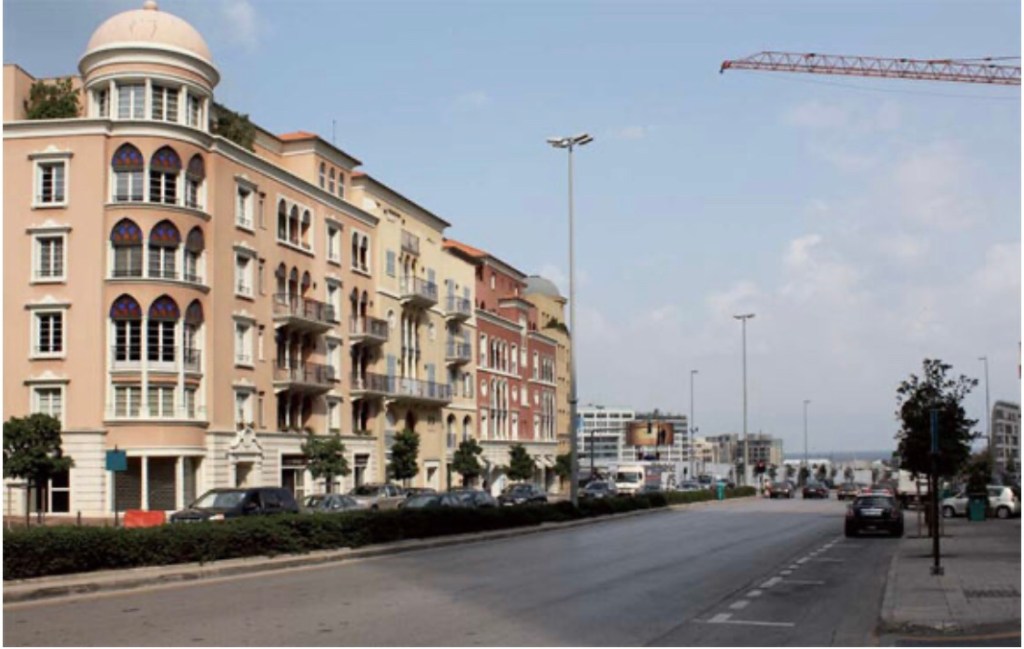
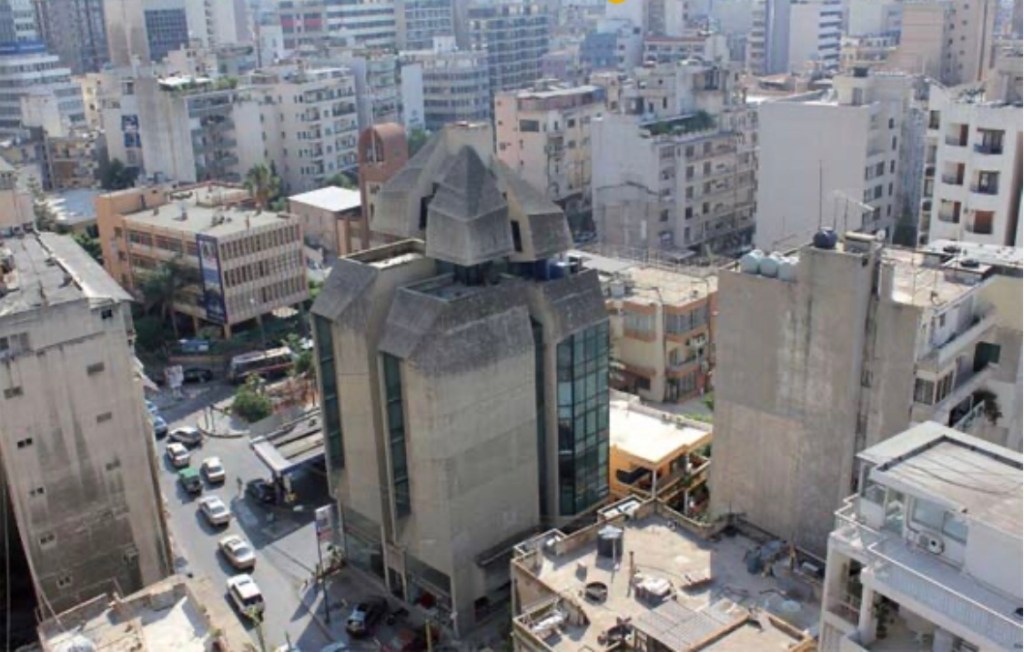
Interdesign building. “The exhibition building of Khalil Khouri. A different kind of modernity.”

Beirut thus has a selective memory. It likes to pick and choose from what its history offers. One part of that history, the civil war, has a certain fantasmatic quality to it. Although the capital is no longer strewn with ruins, those that do remain “exercise a certain fascination”, says Khoury, who criticizes the touristic vision that sometimes reduces the city to a kind of theme park of violence. So he asks the question again: who is to decide which traces should be conserved and what should be effaced? And what is this balancing act that architects are obliged to indulge in? “In this context, they can either hide away in their academic ivory towers or face up to the problems and fight back,” he says, before concluding: “I don’t work for the private sector and if my answers aren’t consensual or ‘moral’ at least, I hope, they are relevant.”

Categories
Uncategorized

Beirut Battles with its history

Categories
Uncategorized

Why Seamless

Having thought about producing a new website seamlessly, the purpose is live. The best sushi in town or the best website in town while Pablo is diffusing an art collective group that is inferior superior or superior inferior to a live. Perspective views is obviously a way or is it a view to deal with the important of a situation that is for Pablo the constructive production of the Puerto Rico Land. Stay Tuned. Stay safe. Stay Locked in.

Categories
Uncategorized

Santa Maria – Mario Botta

De jour comme de nuit, l’église Santa Maria degli Angeli de Mario Botta offre un aspect d’une grande esthétique.


Le viaduc qui permet d’accéder au toit de la chapelle. Photos Copyright Lugano Tourism

Categories
Uncategorized

Put me on Some stats

Politics and Technology could now be related to a circa drawel intended far from accepting the terms and policy of your page on a social platform in comparison with no their page but their polite lifestyle.

Categories
Uncategorized

Paul Moukarzel

Language is an important element of communication which in turn allows people to interact and exchange their culture, their experiences, their knowledge and their art…Communication is behind democracy, human rights, peaceful and respectful relationship and progression. Language is also a way to express our inner secret thoughts.

It was in Mesopotamia, in 3300 BEC, that the 1st written symbolic language, the pictogram (image), was created by Sumerians, who developed it in 3000 BEC, to become the cuneiform graphic. Although the verbal language existed already, the development of the written language arises from the need of this population to leave their communications with the neighboring people as well as their culture, their creativity, their expansion and their history to the future generations. Texts were written in different fields like administrative, religious and even literature, like the 1st famous literary work, the epic of Gilgamesh.

Later on, in 1000 BEC, the Phoenicians invented their own alphabet, the Phoenician alphabet, which is behind almost all the alphabet of the world. It’s from the port of Tyr (Sour) in my country Lebanon (Phoenicia before), that was diffused the Phoenician alphabet to the world. This was behind the development of extended communications between countries, civilizations, leading to culture and commerce exchanges. But from there, languages were diversified and developed according to a number of factors like geographical, cultural, ethnical…a lot of them disappeared later on.

Language can be oral or verbal (voice), written (symbols), visual (images, art…) and even perceptual like it is the case with the Braille (touch), eye and body languages. But, its goal is one: communication.

Language is an accumulation of words, images, sounds or gestural to share our expertise, our experience and to express our thoughts, feelings, ideas, plans, strategies and to develop our creativity. People from the same country or community use usually the same language. The language can also be common to an entire geographical area or to people with a same culture. So, language relies on the culture and the way of thinking of the people from the same community or country.

To practice, understand and interpret all kind of languages, human beings need to have healthy vision, audition and faculty of speech as well as a healthy brain.

Thus, talking and reading the same language is mandatory to let people connect with each others. It avoids misunderstanding and conflict situations behind the violence and even behind wars sometimes. It also allows people to share their own experiences in life or at work, in order to let others take advantage of them and to avoid doing the same mistakes. Language makes history of a person, a family… or an entire civilization which will be communicated to the future generations.

Unfortunately, with the language diversity, we all don’t talk the same language. If some are more worldwide spread like Spanish and English, others like Chinese, Indian and Arabic are less popular around the globe, even with the actual globalization due to the development of technologies leading to better communication.

Thus, the barriers for a visitor, student or a job seeker to not talk the language of the hosted country could be multiple and at different levels, from the basic living needs till understanding the culture, the reason for a holiday’s day, the meaning of a celebration or even appreciating an artwork like a piece of theatre, beside the difficulties encountered at work and college or university. Language is also a barrier to have relationship; making friends will take more times, leading to loneliness and anxiety. It’s a barrier to integration into the society which could be a great disability.

Language is also a way to express and share our inner thoughts, our dreams, our creativity; a poem, a bestseller book, a novel, an artwork or a new invention could be the result of such secret thoughts. But this kind of expression is not comprehensible by all people, even if they understand the language. It’s the language of art with indirect meanings expressing our inner minds.

Diversity of culture and languages is a good thing for the human curiosity and development, even in this globalization era. The rapid development of communications’ technologies is putting people together from all over the world, to share their expertise, make business and relationships…This is the universal language of the future. Unfortunately, the direct human touch will be lost over time.

Categories
Uncategorized

La Ultima Puerta

A doctor and his family are living peacefully in a land that they own somewhere in the Venezuela. One day the doctor thought that the gate of his gigantic house is laking in size, aesthetics and security. So he met with an artist/architect one day after long period of waiting for this appointment due to the overwhelming life of the artist. The artist started working on a sheet of paper, studying the concepts and the best solutions possible to satisfy the client. He started scratching on the first side of the paper couple of sketches and crocus with different methodology and approach. The first side of the paper was completely full so he started thinking deeply to come out with a good idea and started drawing on the other side of the paper hoping that this would be the final version. The two sides of the paper were full, the client had no other choice but to like this version. The doctor who was dealing with kind of pressure to accept this final version representing all the criteria that he asked for, accept it as a first presentiment. However, after having thought about it for another ten minutes in front of the artist, he though that this version was not efficient enough and shows more disadvantages than advantages. Unfortunately, the two sides of the page were full, no more space to draw, no more space for another and final version, this paper was the only piece were they can write on. They started turning the sides over and over searching for a place to draw and finally found a little space on one of the corner of the sheet. The doctor said to the artist: “You saw this little space right there? Draw me the best version of the gate that we both have in mind, think about it logically, clearly and simply. This little space can be enough. We need this gate as soon as possible.”
So as a final chance to satisfy the doctor and his family the artist came out with his best chef d’oeuvre ever, based on a sketch on a space of 5mm by 10mm. This was the most beautiful part of all the chaos that have been drawn all over the sheet.

Design a site like this with WordPress.com
Get started